
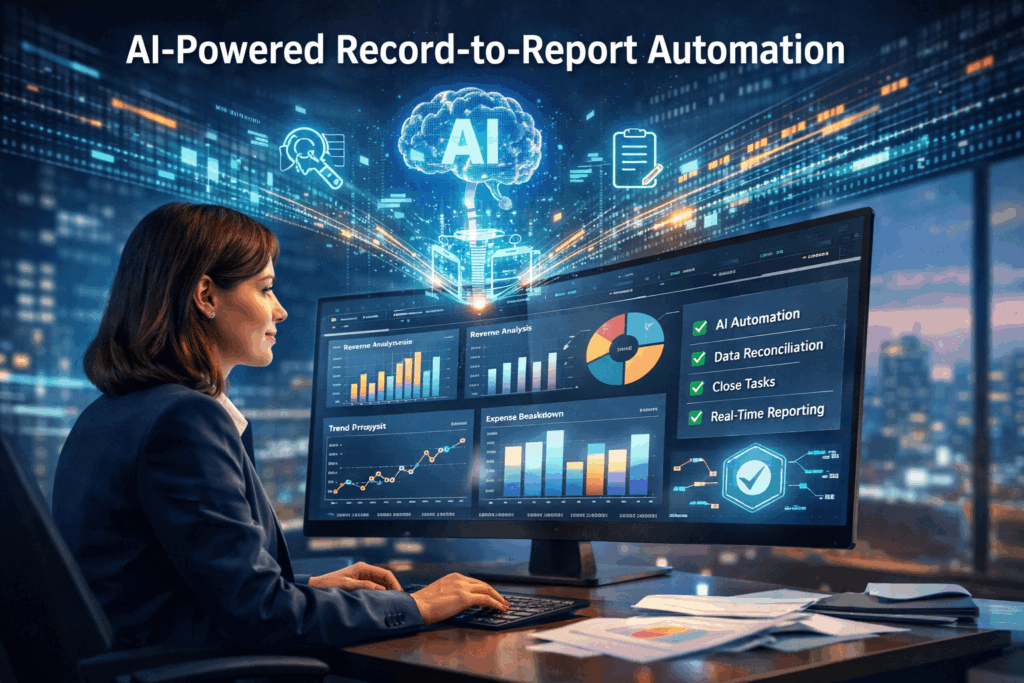
The Record-to-Report (R2R) process is the backbone of every finance function. It transforms raw transactional data into accurate financial statements, management reports, and strategic insights.
However, for many finance teams, R2R remains manual, fragmented, and stressful—especially during month-end close. Disparate systems, spreadsheet dependency, and tight reporting deadlines often lead to errors, delays, and burnout.
With AI-powered finance automation, organisations can now accelerate close cycles, improve data accuracy, and shift finance teams from transactional work to value-adding analysis.
In this article, we explore the top 5 R2R challenges and how Artificial Intelligence (AI) is addressing them—one smart step at a time.
1. Manual Data Entry and Reconciliation
The challenge
Finance teams still spend excessive time extracting data from multiple systems, reconciling balances, and correcting human errors—before meaningful analysis even begins.
How AI solves it
AI-driven bots automate data extraction and reconciliation across ERPs, bank feeds, and sub-ledgers.
Machine learning algorithms detect mismatches, flag anomalies, and continuously learn from historical patterns—reducing errors and rework over time.
Result: Faster reconciliations, fewer manual adjustments, and improved data integrity.
2. Slow and Stressful Month-End Close
The challenge
Traditional month-end close processes are often rushed, repetitive, and highly dependent on manual coordination. Consolidating data across entities and systems increases the risk of delays and misstatements.
How AI solves it
AI-enabled close management tools automate:
- Journal entry preparation and validation
- Approval workflows
- Intercompany matching and eliminations
They also provide real-time close dashboards and intelligent reminders, ensuring visibility and accountability throughout the close cycle.
Result: Shorter close timelines and reduced close-related stress.
3. Inconsistent Data and Lack of Visibility
The challenge
When financial data is scattered across ERPs, spreadsheets, and CRMs, inconsistencies arise—leading to confusion during reviews, audits, and management discussions.
How AI solves it
AI centralises and standardises data into a single source of truth.
Natural Language Processing (NLP) allows finance teams to ask questions such as:
“What changed in revenue this month?”
“Why did expenses increase quarter-on-quarter?”
and receive instant, explainable insights.
Result: Improved transparency, audit readiness, and confidence in reported numbers.
4. Limited Time for Analysis and Insights
The challenge
Many finance professionals spend up to 70% of their time collecting and preparing data, leaving limited capacity for analysis, forecasting, and strategic decision-making.
How AI solves it
AI automates repetitive tasks, freeing finance teams to focus on:
- Performance analysis
- Cash flow optimisation
- Profitability and trend forecasting
Predictive analytics and scenario modelling further enhance decision support.
Result: Finance evolves from scorekeeper to strategic business partner.
5. Knowledge Gaps and Human Dependency
The challenge
When key personnel leave, undocumented processes and Excel-based workflows can disrupt reporting and slow down the close. Knowledge loss becomes a material operational risk.
How AI solves it
AI enables standardised, documented, and repeatable workflows that are embedded into systems rather than individuals.
Recurring tasks are automated, controls are enforced consistently, and institutional knowledge is retained.
Result: Business continuity, scalability, and reduced key-person risk.
Ready to Modernise Your R2R Process?
Leading finance teams are already leveraging platforms such as BlackLine, Workiva, and Microsoft Dynamics 365 Finance to transform their close and reporting processes.
Now is the time to assess where automation and AI can create the biggest impact in your R2R cycle.
Related reads:
Record to Report Process: Benefits, Automation & Best Practices
Agentic AI: Transforming Automation with Autonomous Agents
Guide on how automation supports compliance with major IFRS standards such as IFRS 15, 16, and 17